Mostrando entradas con la etiqueta Nabokov. Mostrar todas las entradas

lunes, 6 de agosto de 2018

Ada, or Ardor - Vladimir Nabokov (21/100)

Staged in a parallel reality called "Antiterra",  Ada or Ardor is a novel by Vladimir Nabokov. It tells the story of two children related by the passion of their ancestry. Van Veen and Ada go further when they decide to trespass the conventions of erotism. They explore each other in Ardor in spite of the curiosity of Lucette, the little sister of Ada.

She is a lover of botany and he is a lover of literature. Both build through the chapters a relationship seasoned by complicity. While they grow up, they have to face the dark side of love. Ada confess she has been with other men; hence, hurt Van abandons the paradise and lives an erotic relationship with a woman in Manhattan. Her sister lives an ordinary life confined to boring jobs and to escort her father.

Distance is the measure of loneliness. Van realizes who his real love is. Both souls gather again but destiny prepares another obstacle for passion. Demon Veen realizes about the real state of the relationship of his children. Van understands inexorability of destiny and separates from Ada, again.

As a result of the games of Ada, Van and Lucette, the little sister falls in love with the boy. This feeling boils in her soul until the lonely Van rejects her during a trip. She suicides. Afterwards, because of a confusion Van is killed by a foreigner. An entire chapter is dedicated to explain time. Then, Van finds Ada again and Lucette has enormous debts.

The two lovers finally spend their last days moving from one villa to another. Violette writes Van memoirs, even detailed descriptions about his sexual sunset.

-

The author creates a parallel world and an ethical issue (incest) in order to allow the reader to focus just in fiction. An association with any real topic perhaps would dilute the quality of the storyline into philosophical argument.

It is not common detailed descriptions in the artwork of Nabokov. Opposed to the common evolution of authors that starts from complex structures to simpler expression, this author chooses a complex, multilingual, detailed and merry style. In fact, the book is very large and sometimes as reader I perceive the narrator deviates to trivial statements.

However, high quality atmosphere constructions may be appreciated through the novel. From Ardor that captures innoncence and erotism to the mental hospitals where the Durmanov sisters die. Villas where the couple spends their last years may be peaceful like the rythm of this book.

-

I think the best part of the book is when Lucette suicides. I can not explain the feeling that caught me: I was astonished and embarrassed for her.  


sábado, 8 de julio de 2017

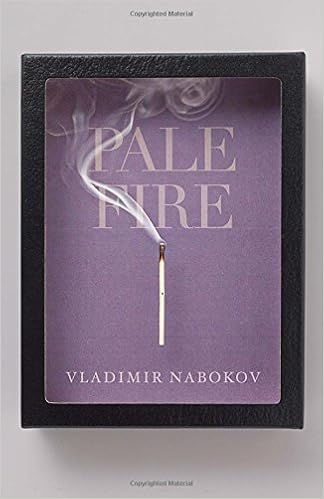
Pale Fire -Vladimir Nabokov (12/100)

Imagen tomada de "https://images-na.ssl-images-amazon.com/images/I/41oRt0-5XXL._SX322_BO1,204,203,200_.jpg"

Finding this book in English in Bogotá was a great task; however, I achieved it. My persistence was because this book has been mentioned as one of the greatest of Nabokov. For me, it was important to read in its original language because I like to keep my vocabulary and I believe writing process is much clearer when the reader has the privilege to appreciate fluency and meanings of the original language of an artwork.

"Pale Fire" was published in 1962. First, it presents a foreword written by Kinbote who also is the author of the analysis in the book. The book shows a poem titled"Pale Fire" by John Shade. Afterwards, it is analyzed by Kinbote. John was writer and collegue of Kinbote, his last artwork is the analized poem. 

Two stories are told simultaneously: The reasons of John Shade to write each line and the life of the king of Zembla who was forced to leave his country and to live escaping of a man who is looking forward to kill him.

In the beginning it is percieved the style of the book: There is a man who is analyzing a poem but is is funny how small sentences are supposed to have deep connections to fiction, philosophy, poetry, personal situations and of course, the life of the Zemblan king. The reader may percieve the reviewer has edited many parts of the original piece fulfilling meaningful passages with simple "etc".

A cursious relationship might also be percieved between Shade and Kinbote. The writers seems not so interested in his collegue who is always spying his friend. Once, very important hosts were invited to a dinner with Shade except Mr. Kinbote. However, at the end, when teachers at the English Department try to investigate the Kinbote's origin, Shade behaves protective and supportive. 

The analysis suggests Shade's death was a mistake of a killer following a Zemblan king who escaped of his country. It would explain the adoration presented by Kinbote. Nonetheless, the end opens the door to believe he is just a mediocre writer trying to believe his story.

I belive it is not a masterpiece of Vladimir Nabokov; however, I have read, it opened the door for metaliterature. From that point of view, I would be more indulgent. To me, making good fiction and good metaliterature as one single peace of art is a great challenge. I loved the doubt Nabokov creates in the writer at the end. It is difficult to understand the personality of Kinbote. Sometimes, I percieved him like a ridiculous blind follower of Shade. At the end, the position of a hidden king made him mores interesting, but what if all was a lie? Great ending.


miércoles, 29 de junio de 2016

Invitation to a Beheading - Vladimir Nabokov (45/50)


Mr Nabokov writes in way easy to free reader from stereotypes, prejudices and boredoom. This time, "Invitation to a Beheading" is the story of Cincinnatus, a prisioner who has been condemened to death penalty because a crime that is not mentioned, only suggested, in the book.

Nabokov's novels tend to focus on good fiction; however, metaphor is used in a fancy and efficient way. Cincinnatus has feature, he is able to be transparent. If it is a symbol or a fact is not clear in the text; however, the main character tends to disengage his body and let the light pass through his body.

Surrounded by ridiculous characters that try to be kind, Cincinnatus keeps his dignity and keeps his temperant attitude. He is introduced to Monsieur Pierre, a extremely courteous man. The prisioner is honest, the partner is friendly. 

Cincinnatus is under the pressure of director and guards will. He has the habit to read; actually, there is a book that particularly interested him: Quercus, which tells the story of a tree a long history. It witness of world changes. 

The story is told in a funny voice. In spite of its merry and simple narrator style, it is unavoidable to feel touched by conversation between Cincinnatus and his mother, Cecilia C. It is supposed to be a comedy or a soft story but cruel Nabokov takes the reader to the heart of an abandoned child whose mother tries to give relief. 

"...'Why do you tell me all this?' asked Cincinnatus.

She was silent.

'What's the point of all this? Don't you know that one of these days, perhaps tomorrow...'

He suddenly noticed the expression in Cecilia C's eyes. -Just for an instant, an instant- but i was as if something real, unquestionable (in this world, where everything was subject to question), had passed through, as if a corner of this horrible life had curled up..."
Cincinnatus reveals in a letter to his wife the relationship they had. It was horrible according the writer. In spite of the straightforward tone of the text, she visits him. Of course, it is suggested she has had sex with the director in order to break the rules. She also does it naturally with one guard. It is told in a delicate ang comic language.

Finally, Monsieur Pierre reveals he is the person who is going to kill Cincinnatus. He has pretended to be a prisioner in order to get Cincinnatus friendship and esteem. The prisioner is near death. He walks in dark places and some beautiful literarian details may be appreciated. For example, when he walks he is able to read "ffice". I consider it a genuine way to express in words the effect of walking fast and barely read an inscription.

When Cincinnates is conceded his final desire, he wishes to have 3 minutes to think. He wonder about what he is living. He becomes big and the executioner small. He walks and leave the place.


I LOVE YOU NABOKOV
   

domingo, 20 de septiembre de 2015

Lolita - Vladimir Nabokov (26/50)


Nabokov's "Lolita" was written in 1955. The author was a lover of butterflies, he researched about them and contributed to classify species. When sauntering in USA to get them, he confesses in "Speak, Memory" he was able to know landscapes, personalities and typical features of the North American culture.

The book is about Humbert, a frenchman born in Paris whose father was a hotel owner and whose Enlgish mother died early. Annabel was a girl with whom he could enjoy love and sexual desire which changed his life for ever.

Humbert has a theory about nymphets which are girls that he admires. When his uncle died, he specified that the heritage would not be given unless his nephew moved to America and showed some interest about the bussiness. 

Valeria (Humbert's wife) decides to escape from that exhausting marriage. She has an affaire with a taxi driver with a Russian aspect. 

Humbert moves to America. He lives with Haze family: Charlotte and Dolores. The character feels a deep atraction through Lolita, Charolotte's daughter. The Frenchman marries her; however, she realizes when reading hid diary that he is deeply in love with Lolita, the nymphet. 

Charlotte dies in a car accident.

Humbert takes Lolita and explains her that she has two options: living with him or becoming an orphan with a terrible lifestyle. She agrees traveling with him; however, she gets tired when starts to meet new people.  She runs away with Clare Quilty a playwright and pedophile. 

Solitud devours Humbert's heart. Hence, Rita enters the picture. He picked her up on the road between Montreal and New York. She was a constant company till one day when he recieved a letter from... Lolita.

It is about Lolita telling him she is married, she is pregnant and she needs some money. Dick (her husband) has debts. Humbert inquiries about the origin of the letter and realizes the nymphet is living in an industrial community to eight hundred miles to from New York City. He leaves Rita and drives towards his loved "Lo".

Humbert visited Lolita, and had an awkward conversation, she states firmly she will never return with him. He leaves Dolores' house disappointed.

Although it was a controversial novel, it is clean, sweet and describes Nabokov's version of USA. 


sábado, 12 de julio de 2014

Slaughter in the Dark - Vladimir Nabokov (13/50)

Margot is a teenager who meets Albinus, a rich artist in Berlin. She realizes about the capability he has to make her a great actrees. She plans to conquer his heart. In spite of his marriage, she separates the couple breaking Albinus' old links.

Rex is an old love come from past, he is an illustrator and friend of Albinus. Desire can not be hidden and Margot and Rex start to play the game of passion. That link strengthen when Margot's debut becomes a failure.

Problems do not stop for Albinus. Paul, his brother in law tells him about Albinus' daughter disease. She dies. The main character refuges in Margot idilic image. They marry.

In the honey moon through dark strategies, Rex escorts the couple. Albinus finds out the adventure of Margot. Anger catches him. He takes Margot and advances rutlessly until they have an accident. He becomes blind.

During the "darkness" of the artist, Margot and Rex enjoy his weak condition. Rex takes risks humilliating  Albinus. Paul gets suspicious about his ex brother in law situation. He visits Albinus and helps him to escape.

Albinus returns to Berlin. He can not speak. The betrayers try to lie him again; however, he has planned a slaughter in the dark.

A clean and beautiful story, probably inspired in the language of movies.

miércoles, 18 de junio de 2014

Speak, Memory-Vladimir Nabokov(11/50)

Vladimir Nabokov was born in St Petesburg in 1899 before the Bolshevik claim for power. Born in an aristocratic family, he had to escape to Crimea in order to avoid the "revolutionary" forces. He lived in London, then in Berlin after finishing his studies in Trinity College, Cambridge. He wrote in Russian and in English; he also domained French. He published novels, translated books; he was professor and one of the greatest writers of XX century. His brother was a great shadow, sometimes the reason to call Vladimir a homophobic great writer.

"Speak, Memory" is a book about the memories of Vladimir Nabokov. The first part is focused on rebuilt images, the strong presence of his mother and the gifts she gave him when he was a child. He describes a powerful family, in a powerful Russia. There is a space of intimacy between Vladimir and his mother, even in hallucinations caused by sounds in which both may give the same descriptions.

In spite of the democratic spirit of Nabokov's father, his feelings towards revolution are related with nostalgia, the sensation of having lost a wonderful world, the nostalgia and "the memory". The author describes how he started to develop a morning passion for hunting and clasifing butterflies.

Nobokov's father was a strong influence. The author describes how they enjoyed chess, their personal jokes, the admiration he had for that respectable character, member of the circles of forense law.Once, the writer believed by mistake his father was going to have a duel, something that broke the beloved boy into tears.

When the story advances, it is described how the Nabokov family must leave Russia, escape to Crimea and then live en Europe. He describes his first adventures of love and his passion for butterflies. However, when he speaks about Sergei, someone who lived a life very similar to Vladimir's, the author tends to take distance and talk from the point of compassion.

When you read it, you do understand why the author felt so sure while living in a Tsarist Russia, even if you firmly defend left wing.